Links
Link text must be descriptive and indicate where the link leads. Don't use vague phrases like "click here".
Vague link text creates barriers for users relying on assistive technologies like screen readers. Screen readers can read out all links on a page in isolation, skipping surrounding content — so a link that just says "click here" gives the user no meaningful information about its destination.
For example:
Correct: For more information, view the university policies.
Incorrect: For university policies, please click here.
A quick test for accessible link text: Remove the link text from its sentence. If it still makes sense on its own, it's descriptive enough to be accessible.
In the example above, "university policies" is clear and logical without any surrounding context, making it AODA-compliant.
The Title attribute can supplement link text with additional context. When a user hovers over a link, a small tooltip appears—this is the Title attribute. It can be used to provide extra detail that the link text alone doesn't convey.
For example:
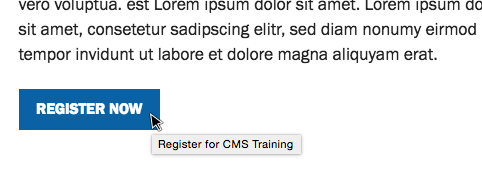
A link that simply reads "Register now" doesn't tell the user much. Adding a Title of "Register for CMS Training" gives it the context it lacks.
Writing effective CTA and heading link text
Headings
Headings should be punchy, direct, and conversational — capable of telling the story in a single line. If a heading is also a link, it must be written to feel actionable, not just descriptive.
CTAs and link text
Strong CTA text is direct, active, and specific. It should:
- Incite curiosity
- Feel relatable
- Build trust or invite proof
For example: "See how we did it," "Start your career," "Join the next generation of X," "See our commitments in action."
Avoid "Learn more"
CTAs are visually prominent and are often the first thing a user reads, before any surrounding copy. A link that says "Learn more" is meaningless without that context. Learn more about what?
Instead, use text that works on its own: "Find your program" or "Co-op and experiential learning" are clear and self-contained. Any accompanying body text should be supplementary; it can expand on the topic, but a user shouldn't need to read it to understand where the link leads.